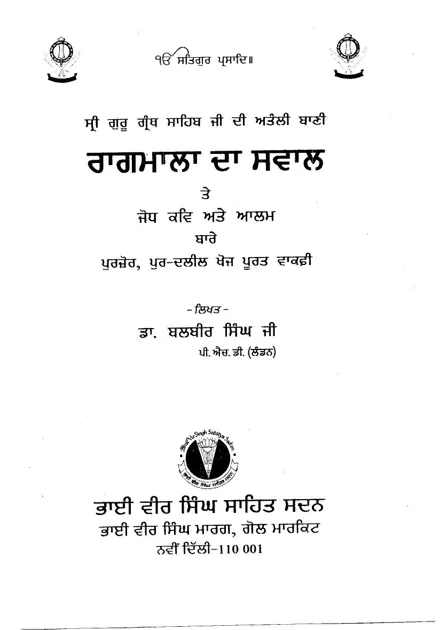
The strength of an argument depends partly on knowing what kind of argument it is. A statement about handwriting, an inference about literary borrowing and a conviction about the authority of scripture can support one another, but they do not perform the same work.
Dr Balbir Singh's Ragmala Da Swal brings all three into a sustained defence of Raagmala. His position is explicit: he regards the composition as belonging to Sri Guru Granth Sahib Ji and challenges accounts that present it as a later intrusion from Alam's romance.
The book deserves to be assessed in that form. Its author is a committed participant in the controversy, combining devotional conviction with manuscript inspection, comparison of editions and close reading. Understanding both the commitment and the method allows readers to identify the questions he asks, follow his answers and assess the evidence he presents.
The theological foundation: the integrity of the Bir
Dr Balbir Singh's opening address places akhandta, the wholeness or integrity of the sacred Bir, at the centre of the question.
He understands Sri Guru Granth Sahib Ji through the authority of the Gurus and the community's relationship to that authority. The Bir is therefore received as Guru, and its preservation carries a responsibility beyond the ordinary editing of a literary collection.
From this position, a proposal to remove or alter a composition demands scrutiny. The question concerns who has the authority to make that decision, as well as whether a particular argument appears convincing to an individual reader.
His account of the Bhasaur controversy supplies the practical background. He connects the removal of Raagmala with other selections, alterations and rearrangements. The history, as he presents it, shows why he fears the consequences of giving later editors control over the form of the scripture.
This concern also explains his refusal to reduce Raagmala to an isolated musical curiosity. A brief concluding composition can become the point at which much larger assumptions about scriptural authority are tested.
The preservation principle is the book's theological foundation. Its historical chapters then argue that the available evidence supports preserving Raagmala in the place it already occupies.
What the manuscript evidence contributes
The Kartarpur Bir provides the most concrete strand of the defence.
Dr Balbir Singh reproduces statements from two inspecting groups in September and October 1945, then supplies his own joint statement with Narain Singh following their December visit. The reports discuss Raagmala's position at number 974, its entry in the contents list and the relationship of its handwriting to the surrounding or main text.
The book also provides tracings of the opening Mool Mantar and Raagmala's final lines. Dr Balbir Singh presents these as supporting the continuity of the principal scribal hand, associated with Bhai Gurdas Ji.
The force of this material lies in its engagement with particular allegations. A claim that Raagmala occupies an unnumbered additional space can be compared with the manuscript's numbering convention. A claim that its hand differs can be compared with the recorded observations. A claim about its absence from the manuscript's original arrangement has to address the contents entry described by the examiners.
Dr Balbir Singh concludes that Raagmala belongs to the Bir from its original writing. That is a conclusion about the history and integrity of the manuscript. It should not be casually expanded into a separate claim that handwriting alone identifies the individual composer of every passage copied by that hand.
Preserving this distinction strengthens the account. The manuscript evidence addresses the question it is equipped to address: the relationship of the entry to the sacred volume and its writing history.
The literary argument asks a different question
The appearance of corresponding material in Alam's Madhavanal Kamakandala introduces the question of borrowing.
Dr Balbir Singh's case begins with the nature of Alam's work. He argues that it combines a Sanskrit source associated with Jodh Kavi, material added by Alam and material taken from elsewhere. The presence of Raagmala in the romance therefore cannot, by itself, establish Alam as its originator.
He then challenges the use of 991 Hijri as a straightforward date for Alam's own activity. His reading places that date with the earlier source whose material was carried into the adaptation.
The later chapters search for a more suitable setting for Alam. They consider his association with the Guru's court, compare his poetry with other courtly writing, and identify parallels with compositions discussed within the Dasam Granth. Dr Balbir Singh also examines how the musical classification fits into the romance's performance scene.
These strands lead him to argue that Alam took Raagmala from Sri Guru Granth Sahib Ji. Their contribution is cumulative: chronology, literary relationship and narrative context are used together to support a direction of transmission.
A useful assessment keeps the parts of that argument visible:
| Kind of material | Its role in Dr Balbir Singh's case | What needs to remain distinct |
|---|---|---|
| Reports of the Kartarpur inspections | Support Raagmala's place within the original Bir | The observations reported and the conclusion drawn from them |
| Shared wording and narrative details | Establish relationships between literary works | The existence of a parallel and the direction of borrowing |
| Dates within texts and closing notes | Help construct a chronology | Source date, composition date, adaptation date and copy date |
| Awkwardness within Alam's performance scene | Supports the argument for insertion of a ready-made classification | A literary interpretation and a direct record of the act of insertion |
| The principle of the Bir's integrity | Explains the duty of preservation | A theological commitment and an independently observable manuscript feature |
The book becomes easier to evaluate when these categories remain connected without becoming interchangeable.
Why spelling is a theological issue in this debate
The chapters on disputed raga names show how a linguistic judgement can become a proposal to alter scripture.
A critic presents one form as correct and another as corrupted. If the allegedly corrupted form appears in Raagmala, the difference is then used as evidence that an unskilled copyist introduced the composition into the Bir.
Dr Balbir Singh challenges both steps. First, he asks whether the comparison text has a sufficiently established reading. His examples from manuscripts of Alam's romance show variation among the copies. A selected form cannot become the standard merely because it supports the preferred conclusion.
Second, he questions the assumption that a word must match its Sanskrit form to be legitimate. Language changes through use. Written forms and pronunciations can vary historically without representing accidental damage to a text.
His discussion of Suhau illustrates the approach. He compares forms across the relevant copies and brings in the use of a related form in the raagmala attributed to Tansen, as discussed in the book. The purpose is to establish a context of usage before declaring the scriptural form mistaken.
The theological implication follows directly. If a later editor mistakes historical language for corruption, an apparent correction can become an alteration to the received text. For Dr Balbir Singh, knowledge of language should help a reader understand the wording rather than provide an unchecked licence to replace it.
Musical objections require musical interpretation
Dr Balbir Singh applies comparable reasoning to Raagmala's organisation.
The composition's family arrangement and the order of raga sections in Sri Guru Granth Sahib Ji do not coincide. His response is to examine their different purposes. The sequence of material within scripture and a classification of musical relationships need not have an identical order.
He also examines the apparent discrepancy between Deepak's eight sons and a sequence that can be read as nine separate names. His answer turns on compound raga names and the principles used to combine or separate them.
The important methodological demand is consistency. When a commentator groups two terms together to explain the number in Alam's list, a corresponding possibility cannot be rejected without examination in the scriptural list. The grouping should be supported through musical terminology and comparison, rather than accepted or dismissed according to which text is being defended.
This argument does not require the family metaphor to supply a complete theory of performance. It requires the reader to establish what counts as one musical name before using an apparent counting problem to judge the text's origin.
Scholarship, reputation and the circulation of error
One of the book's recurring concerns is the power of a respected scholar's name.
Dr Balbir Singh examines changes across Bhai Kahn Singh's writings and argues that later writers continued to circulate earlier descriptions without adequately considering revisions. He also traces allegations that become more definite as they pass from one publication to another.
His target is the habit of treating repetition as verification. Several writers can reproduce the same statement while relying on a single earlier account. The number of repetitions does not establish that several independent examinations have occurred.
He makes a related point about respect. A scholar's contribution can be substantial while a particular claim remains mistaken. Dr Balbir Singh expressly resists the wholesale dismissal of Bhai Kahn Singh's writings, even while criticising specific descriptions with considerable severity.
The distinction is valuable because it protects both intellectual standards and proportion. Respect does not require perpetuating an error. Correcting an error does not require denying everything the scholar accomplished.
The author's own corrections belong in the assessment
The book records occasions on which Dr Balbir Singh changes his own published position on a detail.
He accepts a correction to the date of the first edition of Gurmat Sudhakar, replacing 1901 with 1899. He also corrects his description of Jodh's metre after examining the Sanskrit more closely. The verses are recognised as Anushtubh, and he explains how the earlier presentation had contributed to his mistake.
These are meaningful features of the work. They show the investigation responding to better information and to readers' objections.
They also establish how the collected volume should be used. A statement in an early instalment may be modified later. Extracting only the first occurrence can reproduce an error that the author has already corrected.
The same principle governs his criticism of others: the relevant object of study is the development of the actual printed record. A convenient quotation should not take priority over the author's later clarification.
Where the book leaves room for judgement
A faithful assessment also needs to recognise that the book does not offer the same degree of certainty for every proposition.
Its discussion of the date in Alam Keli explicitly raises unresolved questions about composition, copying and the calendar involved. Its reconstruction of Alam's movements between patrons depends on connecting historical circumstances. Its comparison of poetic style offers interpretative support rather than a dated record of every act of composition.
The vivid passage imagining Alam's acknowledgement of borrowing also needs care. Alam's general statement about using others' material is part of the evidence. The imagined speech identifying the particular borrowing is Dr Balbir Singh's exposition of his case. It is not a separately preserved confession by the poet.
Similarly, the handwriting tracings and inspection statements should be presented as the evidence the book supplies. They should not be described as laboratory tests of ink or paper, and the supplied scan cannot substitute for a fresh examination of the original Bir.
These distinctions do not change the direction of the author's conclusion. They give readers a fair account of how he reaches it and which parts rest on observation, interpretation or reconstruction.
His style is another part of the assessment. The writing can be satirical and confrontational. It emerged from a controversy in which the author believed the integrity of scripture was at stake. Describing it as consistently detached or diplomatically neutral would conceal that character.
The contribution of the defence
Dr Balbir Singh's case joins a clear religious commitment to a demanding programme of textual enquiry. He defends Raagmala's place in the Bir, challenges the claim of borrowing from Alam and asks critics to justify the manuscript descriptions and linguistic standards on which their conclusions depend.
His broader contribution lies in the questions that this work requires readers to ask. Has the right manuscript been identified? Has its numbering been understood? Is a quoted view the author's own, or an objection he is answering? Does a date belong to the source, the adaptation or a copy? Has a supposed correction been tested against the actual witnesses?
For him, the preservation of scripture and the careful examination of evidence belong to the same responsibility. The argument deserves to be represented with equal care: its defence made explicit, its supporting material described accurately, and its inferences distinguished from direct observations.
Read in that way, Ragmala Da Swal offers a substantial account of why its author regards Raagmala as an integral part of Sri Guru Granth Sahib Ji, while leaving the reader able to follow and assess the reasoning on which that account depends.
Source: Dr Balbir Singh, Ragmala Da Swal, supplied 2006 edition, especially printed pp. 1-23, 57-83, 96-117, 123-178 and 181-204. Printed page numbers are six lower than the corresponding PDF page numbers. This assessment uses only the arguments and material contained in the supplied book.