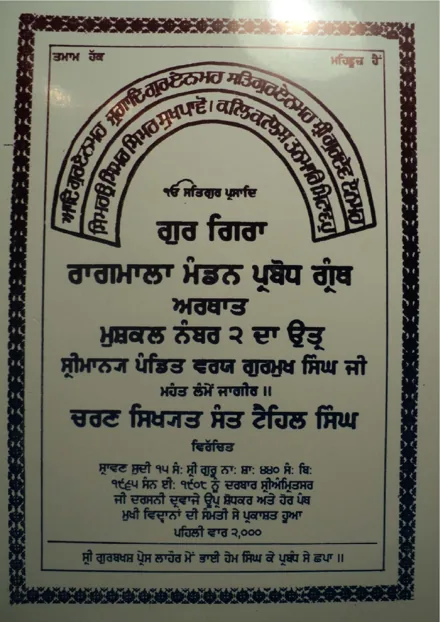
One of the central claims challenged in Gur Gira Raagmala Mandan Prabodh is that Raagmala came from a literary work associated with a poet called Alam. On this account, a passage belonging to the Madhavanal-Kamkandala story entered Sri Guru Granth Sahib Ji from an external source.
Sant Tehal Singh responds at length. He examines the identity assigned to the poet, the versions of the narrative under discussion, competing dates, the wording of musical passages and the circumstances in which Raagmala is said to have entered the scripture.
His conclusion is unequivocal: he defends Raagmala as Gurbani and rejects the proposed secular origin. The argument leading to that conclusion is more complicated than the statement that two passages resemble each other, or that a single date disproves every alternative.
What does the Alam theory actually claim?
The book addresses more than one account of Raagmala's inclusion. Some of the authorities it quotes describe a composition accepted by the Guru. Other formulations suggest that Bhai Gurdas Ji, or an unnamed Sikh, attached it. Another objection treats the passage as a pre-existing literary composition that should have no place in the scriptural reading.1
These accounts raise different questions.
A composition knowingly accepted by the Guru would require an argument about authorised inclusion. An unauthorised addition would require an explanation of who inserted it, when, and how it acquired acceptance. Identifying a passage in another work would raise the further question of which text depended on which.
Tehal Singh repeatedly draws attention to this variation. He wants critics to specify the account they are defending, because evidence for one version does not automatically establish the others.
This is also why the presence of Bhagat Bani matters within his discussion. A claim that words originated with someone other than a Guru is not identical to a claim that they were admitted without the Guru's authority. The book uses that distinction when examining historical accounts that call Alam a bhagat and describe the Guru accepting his contribution.
Tehal Singh does not accept those accounts as the final explanation of Raagmala. He uses them to expose a difficulty in arguments that combine authorised acceptance with unauthorised interpolation as if the two were interchangeable.
The first task is to identify the text
The title Madhavanal does not, in Tehal Singh's treatment, identify a single uniform passage available in one uncontested form. He discusses a Sanskrit narrative, vernacular renderings and musical descriptions associated with the story of Madhavanal and Kamkandala.2
He reports looking through works and collections in several places, and he distinguishes versions that do not contain the relevant passage from versions alleged to preserve it. He also questions whether the copies invoked by his opponents provide a secure basis for the attribution to Alam.
The point is textual before it is chronological. A date attached to one version cannot simply be transferred to every passage in every later rendering of the same story. A title shared across versions does not establish that their contents are identical.
His treatment asks the reader to keep several things separate: the narrative itself, a particular retelling, the musical passage within that retelling, and the attribution of that passage to a named poet.
Those distinctions are easily lost when the theory is shortened to “Raagmala appears in Alam's book”. Tehal Singh's answer is to ask which book, in which form, and on what evidence the wording is assigned to that author.
Why he reproduces several raagmalas
The comparative passages occupy several pages of the work. Tehal Singh reproduces musical enumerations associated with the Madhavanal narrative, a further raagmala attributed in the book to another writer, and the passage presented as Alam's.3
The comparison is useful at two levels.
At the first level, the passages share a musical subject. Raags and raginis are arranged into relationships, with recurring names and groupings. Some agreement can therefore arise because the writers are drawing on a shared musical classification.
At the second level, wording and arrangement may resemble one another more closely. That raises a question about literary dependence. Tehal Singh does not treat the mere recurrence of a raag name as equivalent to the copying of an entire composition.
Some of the reproduced descriptions remain visibly connected to the story's characters and performances. The more closely related passage presents a different problem. Here the question becomes whether resemblance proves movement from the literary narrative into scripture, or whether movement in the opposite direction is possible.
Tehal Singh argues for the latter possibility. He also cites wording from the work under discussion that acknowledges a combination of the writer's own material and the work of others. He interprets that as relevant to the possibility of borrowing.
That observation makes the transmission question more open than a simple attribution suggests. It does not identify the source of every borrowed line by itself. His larger case depends on the dates and manuscript history that accompany the comparison.
The chronological argument, with its premises visible
Tehal Singh treats the Kartarpur compilation dated Bikrami 1661 as a central reference point. Against it, he compares the dates assigned to Alam and to the literary work attributed to him.4
One of his arguments associates the poet described in a literary catalogue with Bikrami 1712. Subtracting 1661 from 1712 gives fifty-one years. On that identification and dating, the literary witness would be later than the compilation with which he associates the Kartarpur Bir.
The arithmetic is simple. The historical identification is the substantive premise.
| Date or comparison in the discussion | Its role in Tehal Singh's argument |
|---|---|
| Bikrami 1661 | The compilation date he associates with the Kartarpur Bir. |
| Bikrami 1712 | The later date he cites in connection with the poet described in the literary catalogue. |
| Fifty-one years | The difference between those two Bikrami dates, conditional on their relevance to the same authorship claim. |
| The verse containing the year 991 | A separate date discussed in relation to a Hijri dating argument and the wording of the narrative. |
| Other earlier dates quoted from critics | Competing claims that the author compares and challenges elsewhere in the rebuttal. |
The book also disputes whether a date in a narrative belongs to the events being narrated, an earlier performance, or the act of composition. Tehal Singh examines expressions referring to past and present while making this distinction.
This matters because a date inside a story is not automatically a date for every surviving form of that story. The author uses that possibility to challenge an apparently straightforward claim of priority.
His later discussion includes an argument about the implausible age a poet would need to reach under another proposed chronology. That should not be merged with the fifty-one-year comparison as though it were the same calculation. The work is responding to several combinations of dates and assumptions.
The defensible explanation of his position is therefore conditional: if the relevant poet and passage belong to the later setting he identifies, they cannot explain an earlier Raagmala in the way his opponents propose. Presenting that as a conclusive calculation without its premises would make the argument sound stronger while making it less accurate.
The court-record argument
Tehal Singh also challenges the placement of Alam in Akbar's court. He refers to the Ain-i-Akbari and to its accounts of court figures, poets and musicians, arguing that the expected identification of Alam is absent.5
Within the defence, this puts pressure on a particular biographical claim. If a theory depends on a poet's documented position in a court, it is reasonable to ask for that documentation.
The limited nature of the point should remain clear. A person's absence from a particular list does not, on its own, prove that the person never existed or never wrote. It challenges an asserted identification more directly than it resolves the entire authorship question.
The evidence here is Tehal Singh's account of those records. He regards the proposed biography as insufficiently established and uses the reference to challenge its documentary basis.
He similarly questions the compatibility between an attribution to a Muslim poet and a version beginning with a Ganesh invocation. That is one of the objections he makes to the attribution. An invocation alone, however, cannot supply a complete history of authorship, adaptation and copying. The textual and chronological questions still have to be answered.
Why disagreement among witnesses matters
The rebuttal quotes Giani Gian Singh's historical writing and Bhai Kahn Singh Nabha's Gurmat Sudhakar. Tehal Singh compares their statements about authorship, date and the person responsible for inclusion.6
He objects when a claim moves between “the Guru accepted it”, “Bhai Gurdas Ji added it” and “some Sikh added it”. He also objects to the use of a named authority when different statements attributed to that authority appear to support different explanations.
The useful principle here is consistency. A witness should be represented with enough context to show what the witness actually asserts. A quotation about a composition's literary origin should not silently become a quotation proving its unauthorised insertion.
The same applies to the book's discussion of Bhai Chaupa Singh's Rahitnama. Tehal Singh distinguishes the cited instruction from the explanatory note attached to it by a later writer. A commentator's interpretation and the wording being interpreted are separate layers of evidence.
His language sometimes becomes personally accusatory. The argument can be understood without carrying those accusations forward. What matters for the reader is whether the evidence has been quoted consistently and whether the proposed account explains the facts it invokes.
The manuscript evidence completes his response
Tehal Singh's final appeal is to the historical birs he describes. He reports Raagmala in the text and indexes of the Kartarpur Bir and other manuscripts, often with what he regards as continuity of handwriting and ink.7
This gives the authorship discussion a further requirement. A theory of later insertion must account for the manuscript evidence as he presents it. It needs more than a similar passage in another literary setting.
For Tehal Singh, the combination is decisive: the competing biographies and dates are unstable, the literary comparisons do not establish the proposed direction of borrowing, and the manuscript tradition supports Raagmala's place in the scripture.
An accurate account of his defence preserves all three parts. It can state his conclusion firmly while identifying the observations and assumptions through which he reaches it. That is the difference between explaining the book's case and merely repeating its verdict.
Source notes
Sole source: Sant Tehal Singh, Gur Gira Raagmala Mandan Prabodh, 54-page scanned edition. Other works named in the article are discussed only as Tehal Singh quotes or describes them. Page references are PDF viewer pages.
- Competing accounts of inclusion, PDF pp. 25, 32-36 and 43.
- Versions, searches and attribution, PDF pp. 25-27.
- Comparative raagmala passages and commentary, PDF pp. 27-31.
- Chronology and calendar arguments, PDF pp. 26-27 and 30-35.
- Court records and invocation argument, PDF pp. 25-27.
- Historical witnesses, Rahitnama and editorial interpretation, PDF pp. 32-36 and 40-43.
- Manuscript survey, PDF pp. 44-51.