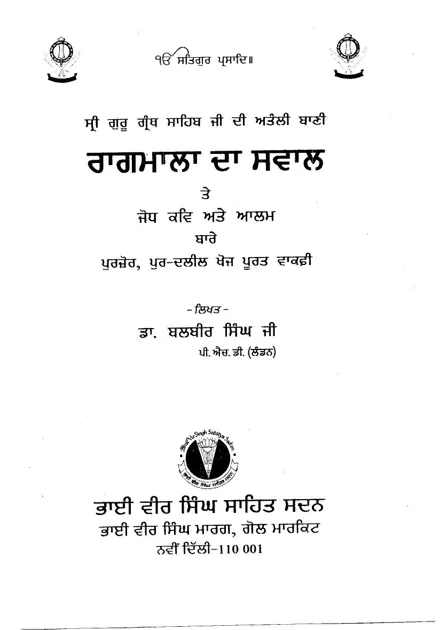
A claim about a manuscript can travel much further than the person who first examined it. Once repeated in books, newspapers and public discussion, it can acquire the appearance of established fact. Recovering the underlying observation then becomes as important as assessing the claim itself.
This problem runs through Dr Balbir Singh's Ragmala Da Swal. His defence of Raagmala repeatedly returns to the physical evidence of the Kartarpur Bir, the wording of earlier reports and the ways those reports were reused. He asks readers to distinguish what someone saw from what another writer inferred or repeated.
The resulting historical discussion centres on four questions: where Raagmala occurs in the Bir, whether it appears in the contents list, whether its handwriting agrees with the surrounding text, and how the manuscript's numbering should be understood. The book presents those questions as grounds for defending Raagmala's original inclusion.
The controversy in which the evidence was gathered
The supplied edition preserves an argument formed during an active public dispute. Its publication history lists articles in Khalsa Samachar during 1945-46, special issues of Khalsa Advocate in December 1946 and March 1947, and publication in book form in January 1969. The supplied edition is dated August 2006.
In the introductory note, Maha Singh Gyani describes the controversy that followed the SGPC's decision to stop Raagmala recitation in gurdwaras under its management in 1945. He credits Dr Balbir Singh's writings with helping to defend its recitation and reports its subsequent restoration. This is the editor's retrospective account, and it establishes the purpose with which the material was collected.
Dr Balbir Singh's opening address provides a longer background. He links the Raagmala question to earlier attempts to remove material from the Bir and to rearrange compositions through publications associated with Bhasaur.
The historical documents he reproduces need to be read according to their particular scope. The Patiala order of 20 May 1918 opposes removing a portion of the sacred volume while expressly declining to settle the theological question of whether Raagmala is Gurbani. The Akal Takht hukamnama dated 6 August 1928 addresses a broader set of alterations to scripture and religious practice.
These episodes help explain why physical inclusion and recitation became connected in the controversy. They do not turn every administrative intervention into the same kind of theological determination. Nor does this historical account, by itself, provide a statement of present-day institutional policy.
The allegations about the Kartarpur Bir
Dr Balbir Singh quotes earlier descriptions associated with Bhai Kahn Singh that place Mundavani at number 973, describe the following numbered space as blank, and treat Raagmala as an addition beyond the original contents.
He also discusses claims that other writings appeared among the Bir's additional material. These include compositions or records whose presence, he argues, had been confused with the contents of another manuscript tradition.
The central issue is the accuracy of the description. If the numbering has been misunderstood, a conclusion about an unnumbered addition may rest on a false premise. If the contents of one Bir have been attributed to another, an argument based on association with additional writings must be reconsidered.
Dr Balbir Singh therefore separates the Kartarpur Bir from the Bir associated with Bhai Banno. The two cannot be treated as a single interchangeable witness. A statement about material in the Banno tradition does not automatically describe what an examiner will find at Kartarpur.
His critique also concerns what earlier descriptions leave unanswered. If someone discusses Raagmala's position but does not clearly report whether its hand agrees with the preceding writing, the physical question remains open. The later inspections become important because they address such points directly.
Three visits to Kartarpur in 1945
The book records three inspections relevant to its case. Their dates and reported findings should remain distinct.
| Inspection | People identified in the book | Principal observations reported |
|---|---|---|
| 10 September 1945 | A group including Man Singh and Hukam Singh, with eight signatories listed | Raagmala at number 974; a corresponding contents entry; consistency in handwriting, paper, ink and line formation |
| 7 October 1945 | Principal Jodh Singh, Professor Teja Singh and Principal Ganga Singh, acting through the SGPC religious advisory structure | Raagmala in the same hand as several preceding pages; number 974 in the Bir and contents list; an explanation of the numbering convention |
| 23 December 1945 | Dr Balbir Singh and Narain Singh, a retired railway officer | Agreement of Raagmala's hand with the Bir's main writing; confirmation of the contents entry; agreement with the September notes they checked |
The September statement concludes that Raagmala was present from the time of the Bir's writing. Dr Balbir Singh uses this report to challenge the allegation that it had been added later by another writer.
The October subcommittee adds a more explicit account of its procedure. As quoted in the book, its members examined the manuscript from midday until a quarter to six and turned through its leaves. They also stated that several additional writings previously attributed to the Bir were not found there.
The December statement records a four-hour visit. Dr Balbir Singh and Narain Singh describe their conclusions in relation to the examination possible within that time. They identify the volume as the original Adi Bir rather than a copy and refer to the shabad sumari, the record of the count of compositions, in support of that identification.
They then affirm their view that Raagmala belongs to the Bir from its original writing. Their checking of the earlier group's notes supplies an additional connection between the visits, although the statement concerns the notes checked during the available time rather than an unlimited examination of every earlier observation.
Why the number 974 matters
The dispute over number 974 can appear like a minor disagreement over pagination. In the book's argument, it has much larger consequences.
An allegation that Raagmala lies beyond the manuscript's original numbered contents can make it appear to occupy an added space. A finding that the contents list directs the reader to Raagmala at 974, and that the text occupies that numbered position, supports a different account of its relationship to the volume.
The October report explains that the relevant numbering unit is not simply the two sides of one physical leaf. It describes the numbered page together with the facing page of the next leaf as forming the unit counted in that arrangement.
This detail matters because an examiner using an assumed modern page sequence could misidentify where one unit ends and the next begins. The manuscript's own convention has to be established before its numbering can support an argument about inclusion or exclusion.
Dr Balbir Singh also compares earlier references to a total of 974 with Bhai Kahn Singh's later description of 975 leaves in Mahan Kosh. He interprets this development as weakening the earlier account that placed Raagmala outside the relevant total.
That interpretation should be attributed precisely. Dr Balbir Singh reads changes in wording, counting and classification as evidence of revision. They should not be rewritten as an explicit declaration by Bhai Kahn Singh accepting every part of Dr Balbir Singh's position. The reader is being shown an argument from the development of the printed record.
The contents list as a separate point of evidence
The tatkara, or contents list, matters alongside the position of the text itself.
In the September report, Raagmala is described as entered in the same hand and ink, with its location given as 974. The October report also states that 974 appears both in the contents list and in the Bir. Dr Balbir Singh's December statement again identifies the contents entry as supporting original inclusion.
The agreement between the reported contents entry and the position of the text is therefore an affirmative part of Dr Balbir Singh's case for inclusion. It also gives readers a specific observation to examine alongside the handwriting evidence.
The distinction illustrates a recurring danger in reading polemical literature. A passage can quote an opponent at length before refuting it. Extracting the quotation without following the response can assign the opponent's claim to the author and reverse the meaning of the chapter.
Following the sequence of quotation, examination and conclusion restores the structure of Dr Balbir Singh's case.
Handwriting and the reproduced tracings
The inspection reports give handwriting an important role. The September group reports consistency with the rest of the Bani. The October group refers specifically to agreement with several preceding pages. The December statement describes agreement with the Bir's main writing.
After discussing his own visit, Dr Balbir Singh provides a further visual aid. Printed pages 179 and 180 reproduce tracings of the opening Mool Mantar and the concluding lines of Raagmala. He states that the tracings were prepared from the Bir during his visit and presents them as examples of the same scribal hand, identified with Bhai Gurdas Ji.
Their function is to let readers see the correspondence he is arguing for. They are selected reproductions within his published presentation of the manuscript.
The evidence should be described at that level. The book offers inspection testimony and comparative handwriting material. It does not report chemical analysis of ink or independently dated tests of the paper. A reader working from the supplied scan can examine the author's reproduced material and account; the physical manuscript remains the object those accounts describe.
This boundary gives the historical evidence its proper form. It prevents the word forensic from implying procedures the source never claims to have performed.
How a possibility became a categorical allegation
The book also follows the claim that Baba Dhir Mal was responsible for adding Raagmala.
Dr Balbir Singh compares wording used by earlier critics with later assertions. In the earlier discussion he quotes, Dhir Mal's involvement appears as a possibility, alongside uncertainty about the person and circumstances. A later statement associated with Giani Shamsher Singh Ashok presents Dhir Mal's authorship of the entry much more directly.
Dr Balbir Singh asks what new evidence justifies that increase in certainty. A suggestion becoming more definite through repetition does not supply the missing documentary link.
He extends the point through a discussion of punctuation in a passage attributed to Bhai Santokh Singh. In his analysis, introducing a comma alters how a statement of uncertainty can be read. The example shows why even apparently small editorial decisions matter when a line is being used as historical evidence.
His stated requirement is that unresolved claims remain unresolved until evidence sufficient to settle them is presented. That principle applies to the wording of the claim as well as to the reputation of the writer advancing it.
Printed editions are part of the evidence too
The manuscript dispute cannot be separated from the history of printed texts. Dr Balbir Singh repeatedly compares editions, dates and copied statements.
He examines the 1917 Gurmukhi edition of Alam's romance associated with Bhasaur and identifies errors through comparison with another version. Some involve misplaced lines whose sequence changes the apparent meaning. Others concern stanza numbering and the handling of additional introductory material.
These are consequential faults when a printed edition is used to challenge the wording or authority of scripture. A comparison is only as reliable as the texts being compared.
The book also preserves the author's own correction of a publication date. Earlier instalments used 1901 for the first edition of Gurmat Sudhakar. In a later chapter, he accepts a reader's correction to 1899 and explains the source from which he had taken the earlier date.
This episode is particularly revealing in a work concerned with the circulation of error. It shows that the obligation to check an edition and correct a mistaken statement applies within the defence itself.
What the historical argument establishes within the book
Dr Balbir Singh draws the documentary strands together in support of original inclusion. The location of Raagmala, the corresponding contents entry, the reported continuity of handwriting and the agreement among the 1945 visits form the main structure of his manuscript argument.
That argument should also be distinguished from the question of personal authorship. Establishing a composition's place in a Guru-authorised manuscript tradition and identifying the individual who composed its words are related enquiries, but they are not identical. The inspection statements primarily address the Bir and the history of the entry.
The author's literary chapters pursue the separate problem of Alam and the direction of borrowing. They complement the manuscript case rather than replacing it.
The historical value of Ragmala Da Swal therefore extends beyond a collection of supporting statements. It records a dispute about how evidence should be handled: identify the correct manuscript, understand its numbering, report the contents accurately, distinguish observation from inference, and check whether a later writer has repeated a claim or actually supplied new evidence.
For anyone approaching the Raagmala debate through this book, those are the habits that make its argument intelligible. They also explain why its manuscript chapters must be read as a defence of Raagmala's inclusion, with the author's evidence and conclusions preserved in their actual direction.
Source: Dr Balbir Singh, Ragmala Da Swal, supplied 2006 edition. Publication history and introductory note: PDF pp. 2-6. Main discussion: printed pp. 15-23, 47-49, 57-83, 89-113 and 176-180. Printed page numbers are six lower than the corresponding PDF page numbers. Reports, documents and other books named here are discussed only as reproduced or described in the supplied source.