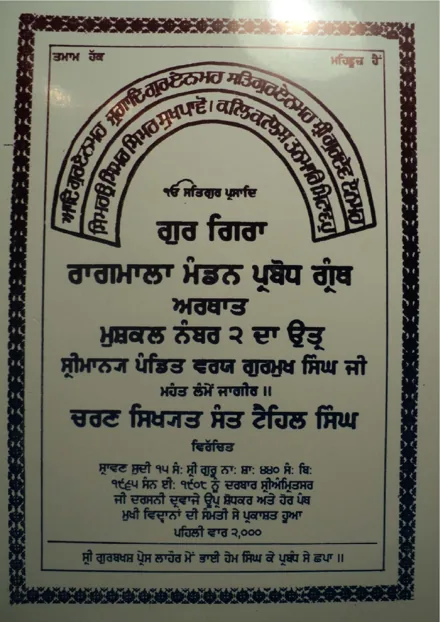
Near the end of Gur Gira Raagmala Mandan Prabodh, Sant Tehal Singh moves from objections about language, authorship and musical classification to the manuscripts themselves.
His question is direct: what do the historical birs say about Raagmala's place in Sri Guru Granth Sahib Ji?
The resulting survey is one of the most substantial parts of his defence. It describes indexes, handwriting, ink, signatures attributed to Gurus, custodians, places of preservation and occasions on which he says he examined particular volumes. It also discusses manuscripts cited by opponents because they did not contain Raagmala.
The survey deserves to be read as a connected account of transmission. Its details reveal how Tehal Singh builds his case and why a list of manuscript names alone cannot convey it.
What the survey is recording
A bir is a volume of the scripture; saroop is the reverential term also used for such a volume. A tatkara is an index or contents list. Tehal Singh repeatedly refers to both smaller and larger indexes and asks whether Raagmala appears in them as well as in the body of the manuscript.1
He also describes signatures, handwriting and seals associated with particular Gurus. These are used to support his assessment of a manuscript's authority. Where he considers the writing and ink continuous, he treats that continuity as evidence against an obvious separate insertion.
The descriptions vary in detail. Some include an account of a personal visit and named companions. Others give a shorter statement about a volume's location, contents or relationship to an earlier bir.
The locations are historical associations recorded in the book. They should not be read as a verified directory of where the manuscripts are kept today. Likewise, the author's attribution of a signature is part of his evidence; the printed account does not itself enable a fresh examination of the original handwriting.
Why the book's total is twenty-five
At the end of the survey, Tehal Singh refers to twenty-five volumes. The descriptions are not twenty-five identical single-volume entries. Some passages group several birs together.2
In particular, he describes four saroops at Patna Sahib, two at Kutewal, and a group of three associated with Pritam Das and Santokh Das. An entry describing four volumes must therefore remain distinct from an entry describing one.
The following guide preserves those groupings. It summarises the claims made in the book, rather than presenting the manuscripts as independently authenticated here.
| Historical association in the survey | Volumes in the entry | Features Tehal Singh reports | PDF pages |
|---|---|---|---|
| Kartarpur Bir | 1 | Raagmala in the main text and indexes; compilation dated Bikrami 1661; writing and marks associated with Guru Arjan Dev Ji and Guru Hargobind Sahib Ji. | 44-45 |
| Bhai Banno Bir, Mangat | 1 | A copying and binding narrative, index entries for Raagmala, continuity of writing and attributed Guru marks. | 45-46 |
| Bir associated with Bhai Milakhi of Peshawar, described at Rawalpindi | 1 | A completion notice dated Bikrami 1662, Raagmala among the concluding contents and an account of the author's inspection. | 46-47 |
| Pindi Lala, district Gujrat | 1 | A connection with the Bhai Banno exemplar, Raagmala in the text and indexes, and attributed marks. | 47 |
| Hakim Buta Singh's family volume, Rawalpindi | 1 | A longer production history, marks attributed to several Gurus, and Raagmala in the volume and index. | 48 |
| Patna Sahib | 4 | Raagmala in the indexed contents and text, with marks attributed to Guru Gobind Singh Ji. | 48 |
| Abchalnagar, Hazur Sahib | 1 | Raagmala and indexes, attributed Guru Gobind Singh Ji marks, and a history of rebinding. | 48-49 |
| An Attock dharmshala | 1 | Raagmala in the text and indexes; Guru Tegh Bahadur Ji's Bani described as added after it. | 49 |
| Bhai Mool Singh family, Peshawar | 1 | A Gurbani volume written in Persian script, with Raagmala and an account of presentation to Guru Gobind Singh Ji. | 49 |
| Choli Bhai Ki, Bhai Nand Chand family association | 1 | Raagmala in the indexes and text, alongside a Guru-associated family history. | 49 |
| Bhai Hem Singh's dharmshala, Lahore | 1 | A volume recovered in loose leaves and rebound; Guru Tegh Bahadur Ji's Bani within the raag arrangement; Raagmala at the conclusion. | 50 |
| Chak Kahna near Akhnoor, Jammu | 1 | A production span given as Bikrami 1662-1663, attributed Guru Arjan Dev Ji marks and Raagmala in the indexes and text. | 50 |
| Bhai Prem Singh's house, Nabha | 1 | A small old volume, writing associated with Guru Har Rai Sahib Ji, and Raagmala in its indexed contents. | 50 |
| Sardar Deva Singh's house, Patiala | 1 | A small-format bir with Raagmala described as continuous with the writing of the volume. | 50 |
| Kutewal, in the Batala area | 2 | Two birs containing Raagmala and index entries. | 50 |
| Bunga Singhian, Amritsar, with Pandit Sarup Das | 1 | A notice associated with Bikrami 1762 and Guru Gobind Singh Ji, together with Raagmala in the text and indexes. | 50 |
| Pritam Das and Santokh Das associations, Amritsar | 3 | Three volumes linked to copying from Kartarpur, described in connection with Amritsar religious establishments. | 50 |
| Takht Akal Bunga Sahib, Amritsar | 1 | A volume presented by Bhai Sant Singh and described as copied from Kartarpur, including Raagmala and its index entries. | 50 |
| Sri Hargobindpur and the Jodh Singh Ramgarhia association | 1 | A Kartarpur-derived copy described in connection with establishment at Goindwal, containing Raagmala and index entries. | 51 |
| Total represented by these groupings | 25 | Sixteen individual volumes and three grouped entries containing four, two and three volumes. | 44-51 |
The survey also mentions other places and volumes in passing. Those brief references should not be expanded into detailed catalogue records without information that the book actually supplies.
Kartarpur and the importance of the index
Tehal Singh gives the Kartarpur Bir a foundational place. He identifies it with the volume written by Bhai Gurdas Ji under Guru Arjan Dev Ji and connects its compilation with Bikrami 1661.1
His claim concerns both the body of the manuscript and its indexes. Raagmala is reported in the concluding text and in the smaller and larger tatkaras. He also describes continuity of the writing and marks attributed to the Fifth and Sixth Gurus. He states that he had visited the volume on several occasions in the company of others.
Why does an index matter? Because it records a composition as an expected part of a volume's contents. In combination with the author's account of the main text, it challenges the suggestion that Raagmala was merely an unrelated passage added at the end without integration into the manuscript.
The index does not, on its own, answer every question about date or authorship. An index can be copied along with the rest of a volume, and its relationship to the manuscript's production still matters. Tehal Singh's argument depends on the combination of index, text, writing and attributed authorisation.
His report is therefore more specific than “Raagmala is in an old bir”. He is describing how it belongs to the structure of the particular witness he regards as central.
The Bhai Banno and Rawalpindi descriptions add a copying history
The Bhai Banno account connects a manuscript's contents with a narrative of copying, travel and binding. Tehal Singh discusses its index entries, writing and Guru-associated marks, then records visits and people connected with the inspection.3
The book also recognises additional material associated with the Banno tradition. This is a reason to read the individual contents descriptions carefully. “The manuscript contains Raagmala” and “every manuscript has exactly the same concluding contents” are different claims.
The bir associated with Bhai Milakhi, described at Rawalpindi, receives a particularly detailed treatment. Tehal Singh reports its concluding sequence, a completion notice and the presence of Raagmala. He also compares features of its contents with the earlier volumes he has discussed.
The Pindi Lala entry is explicitly related to the Bhai Banno exemplar. That relationship helps explain transmission: a later volume may preserve the organisation of the volume from which it was copied.
It also limits how the witnesses should be counted. Two related copies can provide evidence that a textual form circulated. Their agreement does not necessarily constitute two independent records of the form's first creation.
The book's copying relationships are therefore part of the evidence, rather than details to discard while compiling a list of supporting manuscripts.
A Rawalpindi entry includes an admission of uncertainty
The Rawalpindi volume described at Hakim Buta Singh's dharmshala has a longer account of production and family custody. The book prints labelled representations of marks attributed to the Fifth, Sixth, Seventh and Ninth Gurus, and discusses a connection with Guru Gobind Singh Ji.4
A valuable detail follows: a mark attributed to the Tenth Guru is described as difficult to read because its trace is faint or incomplete. Tehal Singh does not present every feature as equally legible.
This helps readers distinguish the record's different levels of certainty. A clear transcription, an attributed mark and an indistinct trace should not become identical “verified signatures” when transferred into a table.
The printed boxes themselves also need to be identified correctly. They set out the words associated with the marks in the book's typography. They are not photographic facsimiles of the original autographs. Readers can examine what Tehal Singh says the marks contain, but cannot use those boxes to compare the original pen strokes.
The position of Guru Tegh Bahadur Ji's Bani reveals different histories
Several descriptions attend to whether Guru Tegh Bahadur Ji's Bani is present and where it appears. In the Attock and Peshawar entries, it is described in a position after Raagmala. In the Lahore volume, the Bani is described within the relevant raag sequence. Other entries note its absence.5
These observations show why a bir cannot be treated as a single undifferentiated object. It may preserve an earlier arrangement, receive additional material, be rebound, or transmit the features of its exemplar.
They also caution against assuming that the last surviving written material in every historical volume corresponds exactly to the liturgical endpoint Tehal Singh is defending. A volume can contain later additions or other supplementary material while still being used by the author as evidence for Raagmala's earlier presence.
The Lahore entry gives a concrete example of material history. Tehal Singh says Bhai Hem Singh obtained a volume whose leaves had become loose and arranged for its rebinding. The contents and the binding therefore belong to distinguishable episodes in the life of the manuscript.
The Peshawar entry introduces another feature: the book describes Gurbani written in Persian script for people who did not read Gurmukhi. That is a claim about script and readership. It should not be converted into the confusing label “Farsi-script Gurmukhi”, which collapses two separate matters.
Manuscripts without Raagmala are part of the argument
Before presenting his positive survey, Tehal Singh addresses copies cited because they lacked Raagmala. He discusses their dates, the absence of marks he considers authoritative, missing material and possible circumstances of copying.6
His explanation is that an omission may arise through error, incompleteness or a copying history that does not carry the same authority as the witnesses he prefers. In some cases, he also reports later corrective action.
These are his explanations of the contrary evidence. The fact that he offers them should not be rewritten as a claim that no manuscript without Raagmala ever existed.
The debate, as his book presents it, concerns the weight assigned to different witnesses. An absence needs to be interpreted in relation to the particular volume. So does a presence. The age of a manuscript, the contents of its exemplar and the circumstances of additions or omissions all affect the historical question being asked.
This is why a simple tally of “with” and “without” would lose much of the argument. Tehal Singh's conclusion rests on his assessment of authority and transmission, not merely on a numerical majority.
What the survey contributes to the defence
The manuscript section makes Tehal Singh's case concrete. It names volumes, records features and directs readers towards the material tradition in which he believes Raagmala's authority is preserved.
Its most useful details are often the ones a short summary overlooks: an index entry, a copying relationship, an inspection with companions, a faint mark, a later addition, or leaves gathered and rebound.
At the same time, the survey remains the record provided by this particular author. The published survey does not establish the present condition of each manuscript, independently date its ink, or authenticate every attributed signature. Its value is the historical testimony and argument it preserves.
Tehal Singh concludes that the birs he describes support Raagmala's place in the scripture and its reading at bhog. Understanding his conclusion requires reading those witnesses individually and then together. The twenty-five volumes become meaningful evidence through their described features and relationships, rather than through the number alone.
Source notes
Sole source: Sant Tehal Singh, Gur Gira Raagmala Mandan Prabodh, 54-page scanned edition. All locations, dates, custody accounts and manuscript attributions are reported as the book presents them. Page numbers refer to the PDF viewer.
- Kartarpur and the opening of the positive manuscript survey, PDF pp. 44-45.
- Grouped holdings, PDF pp. 48 and 50; author's total, p. 51.
- Bhai Banno, Milakhi and Pindi Lala entries, PDF pp. 45-47.
- Hakim Buta Singh's family volume, printed marks and the indistinct Tenth Guru attribution, PDF p. 48.
- Hazur Sahib, Attock, Peshawar and Lahore descriptions, PDF pp. 48-50. The Attock reference to a mark of the Tenth Guru should not be read as marks of all ten Gurus.
- Manuscripts cited for the absence of Raagmala and the author's responses, PDF pp. 43-44.