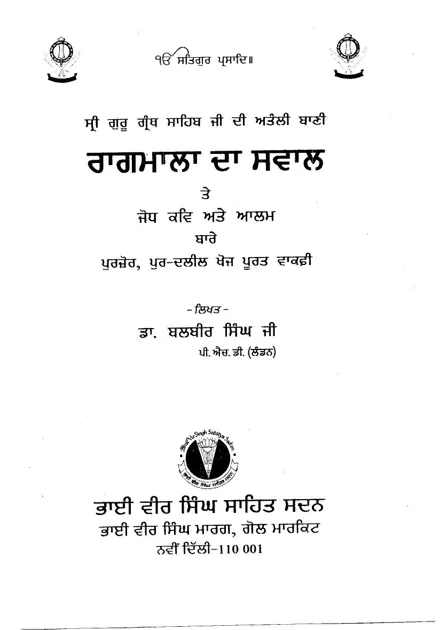
A short composition can carry a debate far larger than its length. Raagmala, the concluding composition of Sri Guru Granth Sahib Ji, brings together questions about music, manuscript history, literary borrowing and the authority to preserve a sacred text. Its family of ragas is easy to recognise. The history of the arguments surrounding it requires much closer attention.
In Ragmala Da Swal, Dr Balbir Singh approaches these questions from a clearly stated position: he defends Raagmala's place within Sri Guru Granth Sahib Ji. His concern is the integrity of the Bir, the volume of scripture, and his investigation challenges the claim that Raagmala entered it through a later borrowing from the poet Alam.
The book combines a presidential address with a substantial series of articles. Its movement between devotional conviction, documentary evidence and detailed literary comparison explains both its force and its complexity. To follow it properly, we need to distinguish the objections he quotes from the answers he gives.
Five connected insights reveal what his investigation is actually trying to establish.
1. The question begins with the integrity of the Bir
Dr Balbir Singh opens his address to the second Raagmala Mandan conference at Sargodha by identifying the larger issue at stake. Mandan here means defence. For him, the controversy concerns the wholeness of the sacred Bir and the responsibility of the Sikh community towards it.
That starting point shapes the book. He understands Sri Guru Granth Sahib Ji as a scripture whose compilation took place under the Gurus' authority. Consequently, proposals to remove a composition, alter its wording or discontinue its recitation cannot be treated as casual editorial decisions. They concern the relationship between the community and the Guru.
His account of earlier controversies makes this concern concrete. He describes the activities associated with Babu Teja Singh of Bhasaur, including the circulation of volumes without Raagmala and subsequent changes made through publications called Gurmukhi Course. In his telling, the dispute developed alongside a wider programme of selection and rearrangement.
The book reproduces a Patiala order dated 20 May 1918. Its significance lies in the distinction it makes between a theological verdict and an administrative response. The order declines to settle whether Raagmala is Gurbani, while opposing the removal of a portion from the sacred volume and requiring the omitted material to be supplied to those who had received the affected copies.
Dr Balbir Singh also reproduces an Akal Takht hukamnama dated 6 August 1928 concerning broader alterations to Gurbani, its order and religious practice. The document belongs to that wider controversy. Treating it as a ruling arising from a single isolated disagreement about Raagmala would flatten the history he presents.
These episodes explain the urgency of his opening address. He fears that accepting one alteration can establish an authority to make others. His defence of Raagmala therefore begins with a question about custodianship: on what grounds can a later reader revise the form of scripture received by the community?
2. A shared passage does not establish who borrowed it
The literary problem appears straightforward at first. Material corresponding to Raagmala occurs in the romance Madhavanal Kamakandala, associated with Alam. Some critics took that overlap to mean that the scriptural composition had been copied from the romance.
Dr Balbir Singh asks a prior question: which text supplied the material to which?
His answer depends on separating three elements that can easily become confused: the story, the Sanskrit work associated with Jodh Kavi, and Alam's adaptation into the vernacular, the language used by a wider readership. Madhavanal and Kamakandala are the principal characters in the story. Jodh and Alam are the poets whose versions he compares.
The date 991 Hijri, which the book equates with 1583 CE, is central to the controversy. If it dates Alam's own composition, it places that work before the compilation of the Adi Granth. Dr Balbir Singh argues, however, that the date belongs to the earlier Sanskrit source and was carried into the translation. A date appearing inside a translated work, on this reading, does not automatically date the translator's activity.
He examines the relationship between the two versions through their invocations, sequence of ideas and descriptions. Alam's work, he argues, contains three kinds of material: passages translated from the Sanskrit source, additions of his own, and material taken from elsewhere.
Raagmala becomes part of the investigation into that third category. Dr Balbir Singh's conclusion is that Alam received it from Sri Guru Granth Sahib Ji and incorporated it into his romance.
The direction of borrowing is his argument to establish. The mere existence of parallel wording cannot do that work by itself. His subsequent chapters therefore look for evidence about Alam's period, literary surroundings and methods of adaptation. The mystery becomes a chronological and comparative problem, rather than a conclusion that can be settled by placing two matching passages side by side.
3. The book presents manuscript evidence in support of Raagmala
One of the most consequential parts of Ragmala Da Swal concerns the Kartarpur Bir. Dr Balbir Singh discusses allegations that Raagmala stands outside the manuscript's original numbered contents or was written by another hand. He then presents inspection reports to challenge those allegations.
The distinction between allegation and response is essential. Claims of different ink, a different hand or an unnumbered addition appear within the controversy he is answering. They are not the findings he ultimately endorses.
A group that inspected the Bir on 10 September 1945 reported that Raagmala appeared at number 974 and was entered at that number in the tatkara, the contents list. Its statement also described consistency in the writing, paper, ink and formation of the lines.
A further inspection took place on 7 October 1945 through a subcommittee of the SGPC's religious advisory body. Its members included Principal Jodh Singh, Professor Teja Singh and Principal Ganga Singh. The report, as reproduced in the book, identified Raagmala in the same hand as several preceding pages and explained how the manuscript's numbering should be read.
Dr Balbir Singh later visited the manuscript himself. His joint statement with Narain Singh records an inspection on 23 December 1945 lasting four hours. They concluded that Raagmala belonged to the Bir from its original writing and that the contents entry supported this conclusion. They also checked notes from the September visit and reported that the notes examined agreed with what they saw.
The book then reproduces tracings of the opening Mool Mantar and Raagmala's concluding lines. Dr Balbir Singh presents these as visible support for his identification of the same main scribal hand at the beginning and end.
These are historical inspection statements and reproduced tracings. Their importance should be explained in those terms. The book does not describe laboratory ink dating or a modern scientific authentication procedure. Its case rests on the observations recorded, the agreement between the accounts and the interpretation of the manuscript's arrangement.
4. Musical classification and scriptural sequence answer different questions
Another objection concerns the order of the ragas. Raagmala begins with Bhairau, while the sequence of raga sections in Sri Guru Granth Sahib Ji begins with Sri Rag. Does that difference establish that Raagmala does not belong?
Dr Balbir Singh rejects the inference. His answer is an analogy from language learning. An alphabet can have one accepted order, while a pronunciation exercise using its sounds follows another. The difference in arrangement does not, by itself, make either exercise illegitimate.
He applies that reasoning to music. Raagmala organises musical names through relationships. Its six principal ragas are associated with raginis and sons. The order of compositions within scripture serves a different organisational purpose. To treat Raagmala as though its only possible function were a matching contents page assumes what still needs to be established.
The later chapters develop a related distinction between a raagmala, which expresses a musical classification, and a raga-namavali, a listing of musical names. This matters to his reading of Alam's romance. A courtly performance scene may naturally contain names of melodies, but a classification also contains explanatory language about their relationships and the practices of singers.
For Dr Balbir Singh, some of that explanatory language sits awkwardly in the scene where Kamakandala is supposed to be performing. He treats the mismatch as evidence that a ready-made classification has been inserted into the story.
The family structure itself comprises six principal ragas, thirty raginis and forty-eight sons, giving eighty-four positions in the scheme. Eighty-four refers to the musical classification; it is not a count of Raagmala's verses. Nor does that arithmetic establish a complete inventory of every possible raga or musical expression.
5. A different spelling is not automatically a corrupted text
The final sections examine attempts to use Alam's text as a standard for correcting Raagmala's musical names. Dr Balbir Singh asks whether the proposed standard is itself stable.
He places readings from several manuscript copies of Alam's work alongside one another. The copies differ. If one version supplies a supposedly correct name while another supplies a different form, the critic must first explain why the selected reading deserves authority.
This leads to a larger question about language. Words change in pronunciation and written form across places and periods. A form that differs from a Sanskrit equivalent is not thereby a copying error. Dr Balbir Singh uses comparisons involving names such as Champak and the forms associated with Suhau to argue that historical usage must be considered before a correction is imposed.
His last chapter applies the same care to counting. Deepak is said to have eight sons, yet a reader can separate the written sequence into nine names. He examines the possibility of compound raga names and compares how other writers have grouped them. The result is an argument about interpretation and consistent standards: a written word boundary does not necessarily identify a separate musical entity.
There is a useful discipline running through these discussions. Before declaring a text defective, establish its language, its technical conventions and the reliability of the comparison being used against it.
Reading the debate with the book open
Ragmala Da Swal is a committed defence, and its language can be sharp. Its claims range from reports of physical inspection to literary and historical inferences. Reading it carefully means preserving those distinctions while following the position its author actually takes.
His central case is that Raagmala belongs within the original scriptural tradition, that the Kartarpur evidence supports its inclusion, and that Alam's romance received material from Sikh sources. The book's discussions of dates, handwriting, translation and musical terminology are directed towards that conclusion.
The lasting value of the investigation also lies in its demand for accurate reading. A shared passage requires a chronology. A manuscript allegation requires an observation. A spelling difference requires a linguistic explanation. A scholar's reputation requires the support of the particular evidence being cited.
Those habits allow the reader to encounter the Raagmala question in its full seriousness, with both the sacred context and the actual documentary argument in view.
Source: Dr Balbir Singh, Ragmala Da Swal, supplied 2006 edition. Principal passages: printed pp. 1-26, 47-69, 123-178 and 181-204; handwriting tracings, pp. 179-180. Printed page numbers are six lower than the corresponding PDF page numbers. All historical works and reports discussed above are encountered through this book; no external sources have been added.