When closely related passages appear in two works, their resemblance can seem to tell a complete story. One author must have borrowed from the other. Establish which work came first, and the direction appears settled.
The Raagmala debate shows how much that apparently simple explanation can conceal. A musical passage resembling Raagmala occurs in the work known as Madhavanal Kamakandala, attributed to Alam. Opponents of Raagmala’s scriptural status have used that relationship to argue that a passage from a literary romance was subsequently introduced into Sri Guru Granth Sahib Ji.
Sant Tehal Singh and Dr Balbir Singh both dispute that direction of borrowing. Their shared argument is not that resemblance is irrelevant. It is that resemblance must be investigated through dates, versions, literary context and manuscript evidence before it can establish priority.
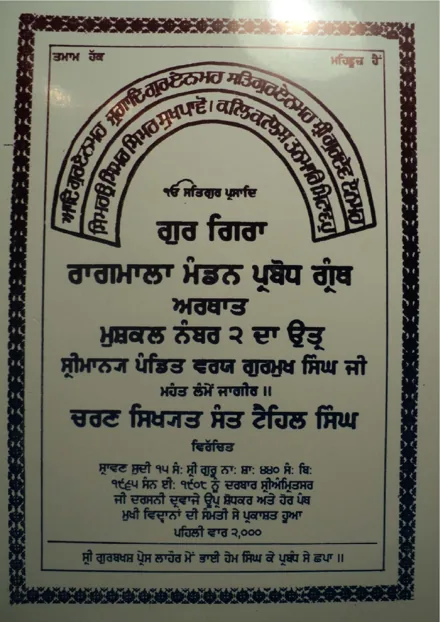
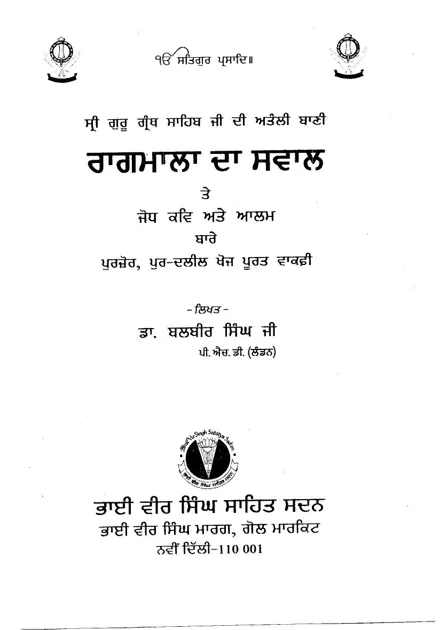
Tehal Singh’s Gur Gira Raagmala Mandan Prabodh Granth challenges the identity and dating of the supposed source. Balbir Singh’s Ragmala Da Swal develops a much more extensive comparison of the literary material. Read together, the books turn an accusation based on parallel wording into a series of questions that the accusation has to answer.
The relationship between two passages is only the beginning
The borrowing claim contains several steps. It assumes that the passage belongs to Alam’s work in a reliable early form; that this form predates Raagmala’s presence in the scripture; and that the direction of transfer runs from the romance into the Bir.
Each step needs support. A later manuscript may preserve an old composition, but it may also contain additions. A translation may retain words from an earlier work while introducing material from elsewhere. A date inside a poem may belong to an underlying source rather than to the version being read.
Both authors object to collapsing these possibilities into a single conclusion. Their preferred explanation reverses the alleged direction: the literary work has drawn on material already present in the Sikh scriptural tradition. Establishing the strength of that explanation requires examining what each author actually contributes.
Tehal Singh questions the proposed original
Tehal Singh’s discussion begins with uncertainty about the text attributed to Alam. He describes searching for the work, discusses differing versions of musical lists, and questions whether the available text can be treated as an established authorial original. His reproduced comparisons show that a raagmala-like musical classification can take different forms in different literary settings.1
This matters because the claim of borrowing requires more than a title and an author’s name. Which version is supposed to have supplied the scriptural passage? Does that version preserve the same wording? How securely is it dated? These questions become unavoidable once variant texts are placed beside one another.
Tehal Singh also draws attention to Alam’s acknowledgement that his composition combines material of his own with material from others. For Tehal Singh, this opens the possibility that the disputed passage was incorporated by Alam rather than originated by him.
The acknowledgement is relevant, but its scope needs to be kept clear. A general statement about using other material does not identify the source of every passage in the poem. It supports investigation of borrowing; it is not, on its own, a confession that Raagmala was taken from Sri Guru Granth Sahib Ji.
Balbir Singh returns to this same opening. He makes the mixed character of Alam’s work a central reason to examine its layers. What Tehal Singh raises as a challenge becomes, in Balbir Singh, a sustained comparison of source, adaptation and addition.2
Balbir Singh distinguishes the story from its adaptation
One of Balbir Singh’s most important moves is to distinguish the Sanskrit work associated with the poet Jodh from Alam’s vernacular treatment of the same story. The existence of an earlier Madhavanal Kamakandala does not automatically date every later version or every passage within it.
Balbir Singh compares the invocations of the two works and finds a close relationship between their ideas and phrasing. He also considers Alam’s own description of working from Sanskrit. These features support his view that the Alam text is an adaptation of an earlier work rather than an entirely independent composition.2
That relationship changes how the date in the poem should be read. The date 991 Hijri, which Balbir Singh equates with 1640 Bikrami and 1583 CE, is important to the claim that Alam’s poem preceded the compilation of the Adi Granth. Balbir Singh argues that the date has been carried over from the underlying work. It therefore cannot simply be assigned to the later adaptation.3
This is the central chronological issue. A retained date can tell us about the material being translated without establishing when the translator produced the version in front of us. To treat it as the date of the adaptation, a reader must first justify that connection.
Tehal Singh also challenges the early dating of Alam, but his treatment is different. He discusses a verse containing the Hijri date and questions the interpretation placed upon it. He then cites a literary notice assigning Alam to 1712 Bikrami, which he places 51 years after the foundational Bir’s date of 1661 Bikrami.4
The agreement between the authors is therefore exact but limited: both reject the automatic use of an early date to establish Alam’s priority. They do not supply one identical chronological demonstration.
Three dates that should remain distinct
The dates in these discussions can easily be turned into a misleadingly neat timeline. A more accurate comparison asks what each date is being used to date.
| Date discussed in the books | What it concerns | How it functions in the defence |
|---|---|---|
| 1661 Bikrami | The foundational Bir, identified by the authors with the compilation under Guru Arjan Dev Ji | The manuscript chronology against which the borrowing claim is tested |
| 991 Hijri / 1640 Bikrami / 1583 CE | A date appearing in the literary discussion of Madhavanal Kamakandala | Balbir Singh argues that it belongs to the underlying work and cannot automatically date Alam’s adaptation |
| 1712 Bikrami | A date assigned to Alam in a literary notice cited by the authors | Tehal Singh uses it to challenge the claim that Alam preceded the Bir; it is not a securely established completion date for the poem |
| 1753 Bikrami | Material and literary relationships examined in Balbir Singh’s later chronological argument | Balbir Singh argues that the adaptation draws on material available at or after this point |
Bikrami is the calendar designation used in the books; dates in different calendar systems should not be compared as if their numbers belonged to the same scale.
Balbir Singh develops his later dating through comparisons with material associated with Guru Gobind Singh Ji’s literary setting. In particular, he examines parallels between the Madhavanal story and the version discussed as the ninety-first charitr. He gives attention to shared wording and to a distinctive test of musical accomplishment involving a lotus leaf. These details, he argues, are more informative than the broad fact that two works tell the same story.5
The inference is that Alam’s adaptation has absorbed material from a later literary environment. If that relationship is accepted, the early date retained in the text cannot be used to make the entire adaptation a source for the earlier Bir.
This remains Balbir Singh’s historical reconstruction. Its force depends on the textual relationships and dates he argues for. The responsible comparative conclusion is that he substantially extends Tehal Singh’s challenge to Alam’s priority, rather than merely repeating the earlier book’s date.
What the passage is doing inside the romance
Chronology is only one part of Balbir Singh’s argument. He also asks whether the disputed musical passage fits its narrative setting.
A scene describing a performer singing before an audience has one kind of task. A classification naming principal raags, raginis and sons has another. Balbir Singh observes that the passage contains language appropriate to a compiler or enumerator and refers to singers in ways that need not describe a single heroine’s immediate performance.6
This leads him to question readings that make every relevant pronoun or verb refer to Kamakandala. Technical musical writing can describe what singers sing and how classifications are arranged without functioning as a narrative report of one person’s actions. The grammar needs to be read in that wider setting.
His discussion of another treatment of the story, by Bodha, sharpens the comparison. Balbir Singh sees a musical explanation placed within a private exchange as better suited to the work of classification. The example helps him distinguish a passage’s subject matter from its literary function: mentioning music does not make every musical passage equally natural in every scene.
Tehal Singh’s reproduced musical lists provide useful background for this argument. They show how related classificatory material can be expanded and reshaped, including versions that make Kamakandala’s role explicit. Balbir Singh then asks what the wording of the particular disputed passage suggests about its use within the story.
The two books thus support a richer inquiry than a search for matching lines. They ask how the lines operate. An incorporated passage may retain traces of a purpose different from the purpose of its new surroundings.
Contextual awkwardness alone cannot prove the direction of borrowing. It becomes more significant when it agrees with a chronological argument and with evidence of the poem’s composite character. That combination is what Balbir Singh seeks to establish.
Which Alam text is being compared?
Balbir Singh also subjects the comparison text to scrutiny. He discusses differences between printed presentations, repeated stanza numbering, errors affecting sense, and variant musical names across manuscript copies.7
The relevance is direct. A modern argument may set “Alam’s original” against the scriptural text as though the former were a single, stable witness. Balbir Singh’s comparisons show why that description needs to be earned. A printed version is a witness to the text, with its own editorial and transmission history.
His later chapters on musical names make the same point at a smaller scale. If copies attributed to Alam disagree with one another, a critic cannot simply select one reading, call it original, and use every difference from it as evidence that Raagmala has been corrupted. The chosen reading requires an argument of its own.8
This strengthens Tehal Singh’s earlier concern about the absence of an unquestionable original. Tehal Singh asks whether the alleged source has been securely identified. Balbir Singh demonstrates the practical consequences of that question through the comparison of readings and editions.
Where the two defences should not be made to agree
The books share a conclusion about the direction of borrowing, but some of their supporting arguments differ considerably.
Tehal Singh questions the compatibility of Hindu invocatory language with the Muslim identity attributed to Alam. Balbir Singh’s discussion allows for a more complicated literary and biographical setting, including mixed invocations and the account of a Brahmin who converted. Religious vocabulary by itself is therefore not a shared proof that can safely be attributed to both authors.9
Balbir Singh is also capable of marking uncertainty within his own dating discussion. When considering a colophon associated with Alam Keli, he asks whether the date records composition or copying, and whether the calendar identification is secure. Those questions concern a related literary witness; they should not be erased merely because his larger argument favours a later Alam.10
There is a further distinction between argument and rhetoric. At one point, Balbir Singh stages an imagined first-person explanation by Alam. It serves his polemical exposition. It is not an independently surviving statement in which the historical poet confesses to taking Raagmala from scripture.11
Keeping these distinctions visible protects the strongest part of the comparison. The defence does not need invented certainty. It needs a clear account of the evidence on which the authors actually rely.
How the manuscript argument completes the comparison
The literary argument becomes most powerful when joined to the evidence of the Birs. Both authors maintain that Raagmala belongs to the original writing of the Kartarpur Bir. Tehal Singh reports its presence in the body and indexes; Balbir Singh reproduces inspection reports and records his own visit.12
If that manuscript identification and assessment are accepted, they place a substantial obstacle before the claim that Raagmala was later imported from Alam’s poem. The proposed source must then be shown to precede the manuscript evidence, or the assessment of that evidence must be challenged directly.
This is the most important reinforcement between the books. The borrowing claim faces pressure from both sides: uncertainty about the alleged donor text’s date and form, and positive testimony concerning Raagmala’s place in the Bir. A parallel passage alone cannot resolve either problem.
The authors’ shared case is therefore stronger than a simple reversal of an accusation. They require an explanation that accounts for the entire relationship: the earlier story, the later adaptation, the wording of the musical passage, the versions in which it survives, and its reported place in the scriptural manuscript. Their defence gains its force from bringing those questions together.
Source notes: This article draws only on the supplied books. Jodh, Bodha, the charitr material, literary notices and editions associated with Alam are discussed through Tehal Singh and Balbir Singh; none has been introduced as an independently consulted source. Printed page numbers precede PDF page numbers.
Source notes
-
Sant Tehal Singh, Gur Gira Raagmala Mandan Prabodh Granth, pp. 24-30 (PDF pp. 25-31). ↩
-
Dr Balbir Singh, Ragmala Da Swal, pp. 24-33 and 50-56 (PDF pp. 30-39 and 56-62), on Jodh, Alam’s adaptation and the admission of incorporating others’ material; compare Tehal Singh, p. 26 (PDF p. 27). ↩↩
-
Balbir Singh, pp. 24-26, 50-56 and 123-124 (PDF pp. 30-32, 56-62 and 129-130). The calendar equivalence is given explicitly on p. 124. ↩
-
Tehal Singh, pp. 25-26 (PDF pp. 26-27); Balbir Singh, p. 124 (PDF p. 130), also discusses the notice assigning Alam to 1712 Bikrami. ↩
-
Balbir Singh, pp. 135-151 and 152-161 (PDF pp. 141-157 and 158-167), especially the narrative comparisons and the inference concerning material dated to 1753 Bikrami. ↩
-
Balbir Singh, pp. 169-178 (PDF pp. 175-184); compare Tehal Singh’s musical passages on pp. 27-29 (PDF pp. 28-30). ↩
-
Balbir Singh, pp. 34-49 (PDF pp. 40-55). ↩
-
Balbir Singh, pp. 181-197 (PDF pp. 187-203). ↩
-
Tehal Singh, pp. 24-26 (PDF pp. 25-27); Balbir Singh, pp. 34-46 and 123-134 (PDF pp. 40-52 and 129-140). ↩
-
Balbir Singh, p. 151 (PDF p. 157). ↩
-
Balbir Singh, pp. 84-88 (PDF pp. 90-94). ↩
-
Tehal Singh, pp. 43-44 (PDF pp. 44-45); Balbir Singh, pp. 59-69 and 176-180 (PDF pp. 65-75 and 182-186). ↩