A claim that a composition was added to scripture is a claim about something that happened to a text. At some point, according to that explanation, words absent from an earlier form entered a later one. Arguments about literary style or musical vocabulary can suggest questions, but the handwritten volumes themselves bring the discussion closer to the proposed event.
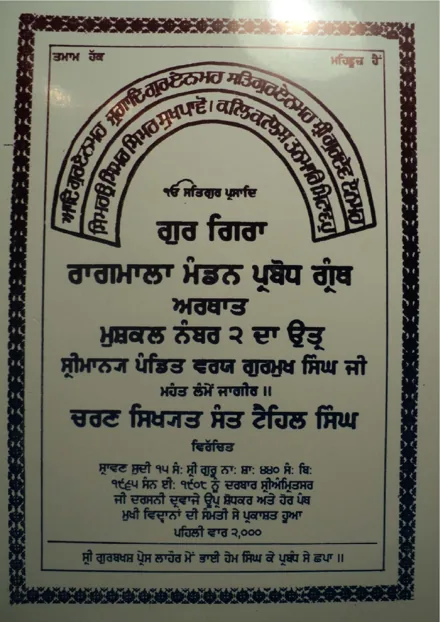
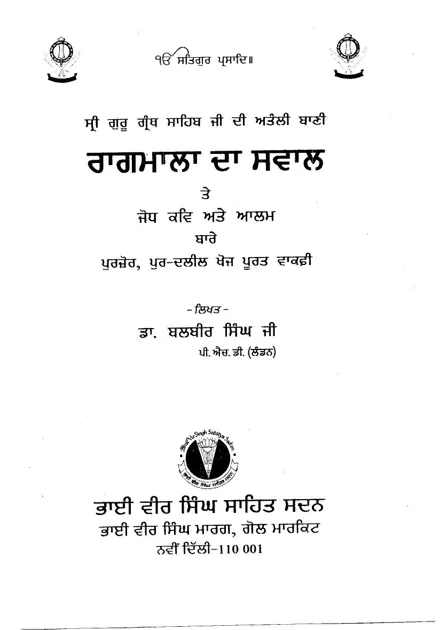
This is why the Birs occupy such an important place in both Sant Tehal Singh’s Gur Gira Raagmala Mandan Prabodh Granth and Dr Balbir Singh’s Ragmala Da Swal. A Bir is a volume of the scripture; in these discussions, the authors are particularly concerned with historic handwritten volumes. Both ask whether Raagmala belongs to their original writing or appears to have been introduced afterwards.
Tehal Singh contributes an inventory extending across several locations and custodians. Balbir Singh gives sustained attention to the Kartarpur Bir, reproducing inspection reports and adding an account of his own examination. Their work reinforces one another through the combination of breadth and detail.
The resulting case is much more specific than the assertion that Raagmala has long been accepted. It concerns writing, indexes, pagination and the relationship between the disputed composition and the rest of a manuscript.
What would make a manuscript observation significant?
The presence of Raagmala in a manuscript is an important starting point, but the two authors frequently ask for more. Does its handwriting agree with the surrounding text? Does the ink appear consistent? Is the composition included in the tatkara, the table of contents or index? Does that entry point to the place where Raagmala actually occurs?
These observations address different possibilities. A composition written on spare leaves at a later date could have a different relationship to a volume from one copied continuously with the main text. Likewise, an index entry agreeing with the text can support the view that the composition belonged to the manuscript’s planned arrangement.
That is why the recurring references to one pen or one hand matter. They are claims about continuity within a physical witness. The claim becomes more informative when accompanied by a named volume, a location, a date of inspection and an account of what was examined.
Such observations should also be described accurately. A historical reader’s judgment that ink and handwriting match is visual testimony. It is not a laboratory analysis of ink or paper. The books’ manuscript case should stand on the evidence they actually report.
Tehal Singh’s move from argument to named volumes
Near the end of his book, Tehal Singh turns to a sequence of descriptions of old Birs. He identifies locations and custodians, discusses signatures and dates attributed to the volumes, and repeatedly notes the presence of Raagmala in the text and in indexes.1
The Kartarpur Bir comes first. Tehal Singh identifies it as the original Bir prepared under Guru Arjan Dev Ji through Bhai Gurdas Ji. He states that Raagmala is present in the same writing and in both the smaller and larger indexes. On the following page, he says that he has visited the volume on several occasions in the company of others.2
His account of the Bir associated with Bhai Banno at Mangat is more expansive. He describes a gathering at which the volume was viewed, records the question of whether Raagmala appeared in the same ink and hand, and names several people present. The report is framed as a public examination connected with his defence of the composition.3
The later entries extend the geographical reach. They include volumes at Rawalpindi, Attock and Lahore, alongside other locations. Some entries give a date and companions for Tehal Singh’s own visit. Others are shorter descriptions or invitations to readers to investigate. These different forms of testimony should retain their distinctions.
| Volume or location in Tehal Singh’s account | What he reports | What it contributes |
|---|---|---|
| Kartarpur Bir | Raagmala in the text and indexes, with continuity of writing; repeated visits | The connection with the foundational manuscript claimed by both authors |
| Bhai Banno Bir at Mangat | Examination in company; Raagmala and the preceding closing material described as continuous in hand and ink | A second manuscript tradition with a reported occasion of inspection |
| Attock volume | Raagmala in the text and indexes; a visit with named companions | A further located witness to its transmission |
| Lahore volume in Bhai Hem Singh’s care | Raagmala in the text and indexes, described as written in the same hand and ink | Additional testimony from another custodial setting |
Tehal Singh describes his closing inventory as covering twenty-five volumes. The value of the list is not simply its size. It gives the reader places, custodians and features to examine. His defence moves from a general appeal to tradition towards assertions attached to particular objects.4
Why a longer list is not automatically twenty-five independent proofs
Tehal Singh’s own descriptions also show why manuscript evidence needs interpretation. He identifies some volumes as copies belonging to a particular line of transmission. Related copies can demonstrate circulation and continuity, but they may share a single earlier exemplar.
Consequently, the number of volumes and the number of independent lines of evidence are different questions. Several copies can preserve the same inherited arrangement. Their agreement is still valuable, especially when compared with a proposed late or local addition, but their relationships affect how much independent confirmation they provide.
The book also discusses reports of Birs without Raagmala. Tehal Singh answers those cases by proposing explanations involving omissions, incomplete copying and the circumstances of particular volumes.5
This is an important feature of the source. His defence is not accurately represented by saying that every old manuscript contains Raagmala without exception. He acknowledges the contrary examples raised in the debate and argues that their absence can be explained.
The comparative point is stronger when stated precisely: the presence or absence of a passage has to be understood through the history and condition of the witness. Neither a count of manuscripts nor an isolated omission supplies the whole explanation.
Balbir Singh concentrates on the Kartarpur Bir
Balbir Singh develops the manuscript discussion by focusing on specific disputed assertions about Kartarpur. His concern is not only whether Raagmala can be found somewhere in the volume. He asks whether it lies within the manuscript’s recorded extent, whether the index agrees, and whether its writing belongs with the main text.
He reproduces a statement following an inspection on 10 September 1945. The eight signatories report Raagmala at the manuscript’s numbered location 974. They describe agreement in writing, paper, ink, line formation and related features, and state that the index also lists Raagmala at that number. They conclude that it was present from the time the Bir was prepared.6
The number 974 belongs to the pagination of the manuscript being discussed. It should be retained in that context. Replacing it with the familiar pagination of a different format would obscure the precise issue being examined.
Balbir Singh then introduces an inspection undertaken on 7 October 1945 by a subcommittee of the religious advisory body of the Shiromani Gurdwara Parbandhak Committee. The report bears the names of Principal Jodh Singh, Professor Teja Singh and Principal Ganga Singh. It explains the pagination and confirms the agreement between the index reference and the location of Raagmala.7
This Professor Teja Singh should not be confused with Babu Teja Singh of Bhasaur, whose publications Balbir Singh criticises elsewhere. The shared name can otherwise make the account needlessly confusing.
The significance of the October report lies in its response to a particular problem: how the manuscript’s leaves and openings are numbered. If the numbering system has been misunderstood, an argument that Raagmala sits outside the recorded manuscript can rest on a mistaken description of the object.
Balbir Singh’s own inspection
Later in the book, Balbir Singh records a visit to Kartarpur on 23 December 1945 with Sardar Sahib Narain Singh, a retired railway officer from Amritsar. Their signed statement reports four hours with the Bir. They identify it as the original Adi Bir, affirm that Raagmala at location 974 belongs to its original writing, and say that the index supports the conclusion.8
The statement also describes a check against notes from the September inspection. The points they were able to examine in the available time were found to be correct. This is a useful qualification: it records the extent of the check rather than claiming an unlimited examination of every earlier observation.
Balbir Singh then provides reproductions he identifies as tracings from the beginning and end of the manuscript. He uses them to illustrate his claim of continuity in the writing. The pages are presented as tracings, and should be described that way; they are not photographs of the original leaves.9
Taken together, the three 1945 accounts offer a series of identifiable examinations:
| Inspection | Evidence emphasised in Balbir Singh’s account |
|---|---|
| 10 September 1945 | Raagmala at 974; agreement in writing and physical appearance; matching index entry |
| 7 October 1945 | Explanation of pagination; agreement of index and text; findings about the volume’s contents |
| 23 December 1945 | Balbir Singh and Narain Singh’s judgment on original writing; confirmation of the earlier notes they checked |
These are distinct reported visits, though the later examiners knew of and checked earlier observations. Their relationship is better described as repeated examination and cross-checking than as three entirely isolated discoveries.
Keep the manuscript traditions separate
One further feature of Balbir Singh’s discussion is especially important for comparing the books. The October report states that several additional compositions attributed to the Kartarpur Bir in earlier descriptions are not present in the volume inspected. Balbir Singh uses this to challenge the accuracy of those descriptions.7
Tehal Singh, meanwhile, discusses additional closing material in the Bhai Banno tradition and in other volumes. Those accounts should not be merged into a single composite description of “the ancient Bir.” Different manuscripts can have different contents and arrangements.
This distinction protects the argument about Raagmala. An observation made about one manuscript cannot be transferred to another merely because both are old Birs. The claim needs to stay attached to the witness: which volume, which passage, which index, which hand?
Here Balbir Singh’s close focus strengthens the use of Tehal Singh’s wider inventory. The earlier book supplies a range of witnesses; the later book demonstrates the importance of resolving disputed descriptions of a particular witness.
What the agreement between the authors adds
The authors’ most consequential agreement concerns Kartarpur. Tehal Singh reports Raagmala in the manuscript’s continuous writing and indexes. Balbir Singh provides later inspection testimony addressing the same features in greater detail. Their descriptions converge on a composition integrated with the volume, rather than merely attached to it without relation to its arrangement.
For their defence, this has direct implications for the claim of a later addition. Such a claim needs to explain the reported continuity of writing and the index entry. It also needs to account for the transmission reflected in other Birs. The manuscript evidence therefore places a substantial burden on a theory built only from literary resemblance to Alam’s poem.
The practical limits remain clear. These books provide historical descriptions and reports; reading them does not amount to personally examining the original manuscripts. Moreover, identifying a passage as part of a manuscript’s original copying addresses its place in that witness. It does not, by itself, identify the individual who first composed every line.
Those limits do not cancel the evidence. They identify its strongest application. Tehal Singh and Balbir Singh offer a cumulative case for manuscript continuity, joining a range of reported witnesses with repeated, detailed examination of Kartarpur. Their shared question is concrete: does the proposed story of insertion adequately explain the manuscript as these observers describe it?
That question gives the debate a firmer historical centre. Raagmala’s place must be considered through the recorded features of the Birs as well as through the arguments made about its words.
Source notes: All manuscript details are reported from the two supplied books. Dates, custodians, locations, signatures and identifications are those recorded by the authors; this article does not claim a new examination or establish present-day custody. Printed pages are followed by PDF pages.
Source notes
-
Sant Tehal Singh, Gur Gira Raagmala Mandan Prabodh Granth, pp. 43-50 (PDF pp. 44-51). ↩
-
Tehal Singh, pp. 43-44 (PDF pp. 44-45). ↩
-
Tehal Singh, pp. 44-45 (PDF pp. 45-46). ↩
-
Tehal Singh, pp. 45-50 (PDF pp. 46-51); Attock on p. 48, Lahore on p. 49, and the author’s total on p. 50. ↩
-
Tehal Singh, pp. 41-43 (PDF pp. 42-44), discussing the three manuscript objections and his responses. ↩
-
Dr Balbir Singh, Ragmala Da Swal, pp. 59-60 (PDF pp. 65-66). ↩
-
Balbir Singh, pp. 60-69 (PDF pp. 66-75), including the October subcommittee, the contents findings and the explanation of pagination. ↩↩
-
Balbir Singh, pp. 176-177 (PDF pp. 182-183). ↩
-
Balbir Singh, pp. 178-180 (PDF pp. 184-186). ↩